Written by: Suhaib Shams
The journal "Geomechanics and Geophysics for Geo-Energy and Geo-Resources" has published a new geomechanical study revealing the relationship between surface subsidence caused by coal mining and the transverse shear load experienced by natural gas wells in co-exploitation zones.
An Integrated Analytical Framework
The study was led by researcher Junqi Lai and his team, focusing on the challenges facing the integrity of gas wells when they penetrate thick unconsolidated sand layers, bedrock, and coal-bearing strata disturbed by longwall mining. The research integrated theoretical analysis, 3D numerical modeling, and measured field subsidence data.
Shear Force Concentration Mechanism
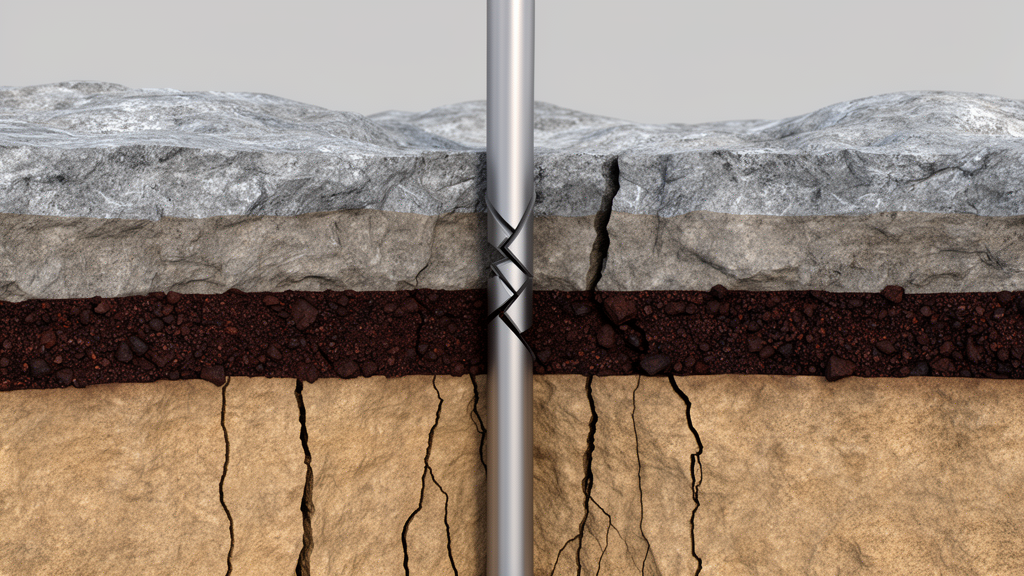
The results showed that differential movement between the sand layer and the bedrock leads to an asymmetry in active and passive soil pressures, which concentrates additional transverse shear force near the critical separation surface. This force reached 71.6 kN, accompanied by a reversal in lateral bending moment from positive to negative values.
Tolerance Limits and Failure Sequence
Modeling recorded peak bending values of 26.4 kN·m in the positive direction and -24.8 kN·m in the negative direction. Under continuous lateral load, the cement sheath reaches its shear limit before the steel pipes, indicating that localized cracking in the cement may threaten zonal isolation and increase the risk of gas leakage.
Ultimate Capacity Model and Linear Relationship
The study utilized an upper shear capacity model that estimated the ultimate cross-sectional shear capacity of the cement sheath at 107 kN. Additionally, a linear relationship between surface subsidence and transverse shear force was calibrated, resulting in a transfer coefficient of 1.087 kN per millimeter, with an R-squared value of 0.982, indicating a strong linear correlation.
Critical Threshold and Risk Control Zone
Based on this relationship, the study identified a critical surface subsidence threshold of 98.4 mm. By applying conservative limit state assumptions with an empirical safety margin, the researchers recommended a risk control displacement of 404 meters from the centerline of the subsidence basin. The resulting framework provides a tool for assessing well integrity, controlling gas leakage risks, and optimizing mining boundaries in co-exploitation zones.