Written by: Fatima Younis
Chinese solar module manufacturing giant JinkoSolar announced the development of a new photovoltaic cell technology called Tunnel Oxide Passivated Contact (TOPCon) based amorphous silicon passivated cell technology, abbreviated as TAC. The revelation came during the company's Global Technology Day event held in Shanghai in mid-October this year.
Advanced Technical Specifications
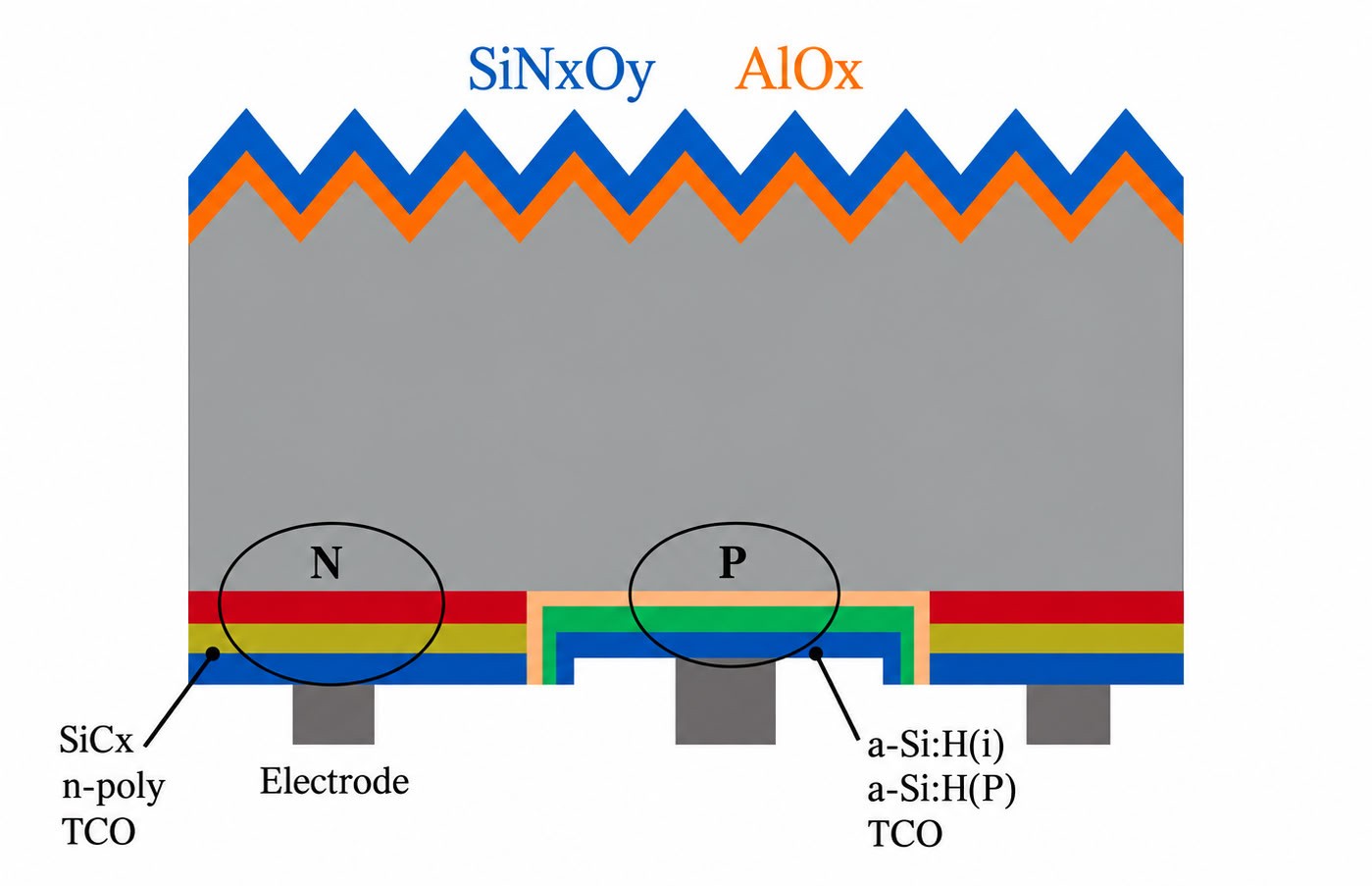
This new technology relies on an innovative architecture that combines electron-selective contacts using TOPCon technology with hole-selective contacts using heterojunction technology, known as HJT, along with rear-side electrode distribution. The technology utilizes an n-type crystalline silicon wafer, with all positive and negative electrodes placed at the rear, eliminating front-side metallization on the cell and thereby removing optical shading losses that affected the efficiency of traditional panels.
Performance and Sustainability Development
The company explained that this hybrid design, which it describes as 2+1, directly contributes to improving surface passivation and increasing the open-circuit voltage of the cell. The amorphous silicon passivation process operates at low temperatures reaching below 200 degrees Celsius, ensuring high manufacturing precision. JinkoSolar has also developed additional processes such as global surface passivation and multi-dimensional charge passivation processes to reduce recombination losses at the edges of cut cells.
Future Prospects for TAC Technology
The production efficiency of TAC cells has reached over 27%, with a peak efficiency of 28% recorded in laboratory tests, making it a qualitative leap in the solar energy world. The company plans to explore additional development areas including the use of copper-containing contact materials, the adoption of low-temperature metallization techniques, and studying the possibility of using TAC technology as a foundational platform for perovskite-silicon tandem devices, opening new horizons to enhance energy conversion efficiency in the near future.